 AvaTrade
Consider whether you understand how leverage works before committing funds.
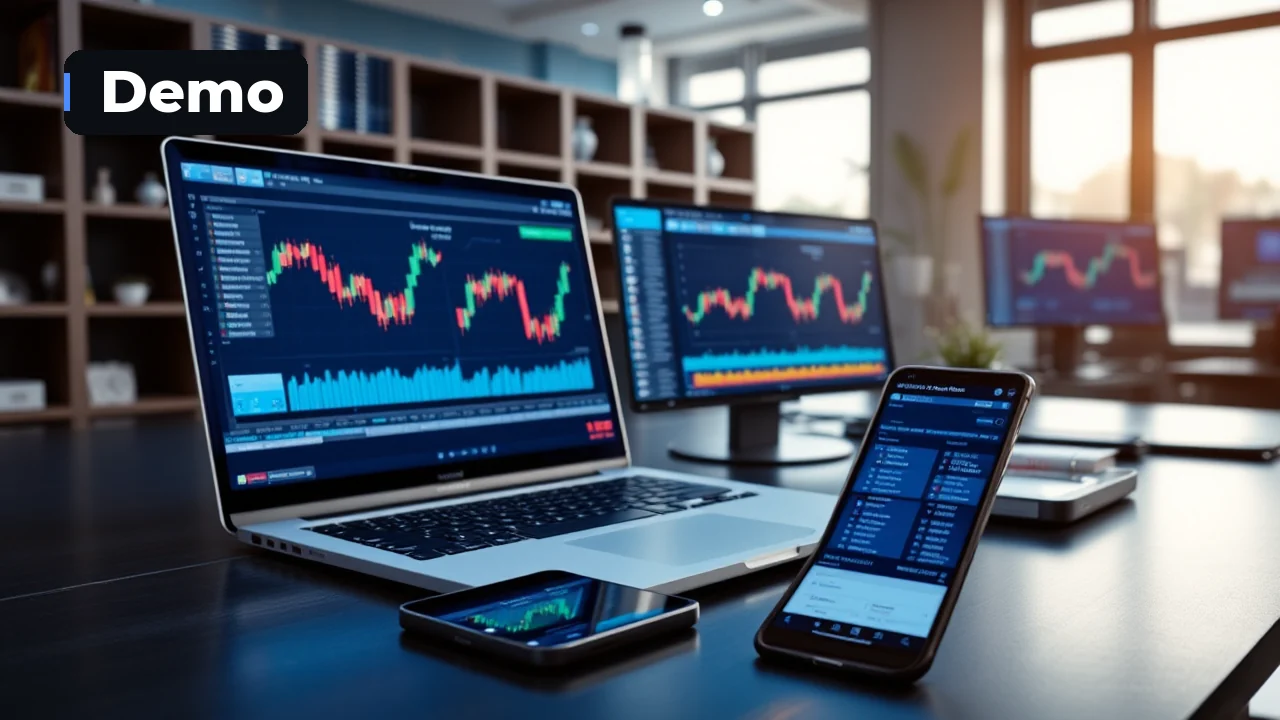
Starting with a demo account is the smartest first step into online trading. It lets you learn the platform, test strategies, and see how the market moves without putting a single shilling on the line. The AvaTrade demo gives you virtual funds to trade with, mirroring the real market conditions you will face when you decide to go live.
What You Get on the Demo
The demo account is designed to be a one-to-one replica of the live trading environment. You get access to the same platform suite, the same instruments, and the same execution model.
- Virtual funding to trade with, so you can experiment freely
- Access to MT4, MT5, WebTrader, and AvaTradeGO
- A full range of instruments: FX, indices, shares, commodities, crypto CFDs, and options
- Real-time market prices and spreads
Your focus on the demo should be the mechanics: how to open an order, set a stop-loss, and calculate your position size.
How the Practice Environment Works
A demo platform does not route your orders to the interbank market. It simulates execution based on live price feeds. This means you practice with real market prices, but your trades are matched internally.
On a spread-based broker like AvaTrade, the cost of a trade is built into the difference between the bid and ask price.
| Feature | Demo Account | Live Account |
|---|---|---|
| Market Data | Live | Live |
| Execution | Simulated | Real |
| Funds | Virtual | Real (min USD 100) |
| Risk | None | Market risk |
On the demo, there is no psychological pressure. That is an advantage for learning the software, but it does not prepare you for the emotional side of trading with your own money.
The Real Conditions to Expect
When you move to a live account, Kenyan residents are served by Ava Trade Markets Ltd, a BVI entity regulated by the BVI Financial Services Commission under licence SIBA/L/13/1049. This is an offshore licence, not a CMA Kenya licence.
The trading conditions are:
- Leverage up to 1:400
- No commission, spread-based pricing
- NAS100 spreads from ~0.9 pip
- Minimum deposit of USD 100
- Base currencies: USD, EUR, GBP
The lack of a CMA licence means if a dispute arises, you are subject to BVI regulations, not Kenyan ones.
Funding Your Account: The Local Angle
AvaTrade supports cards, wire transfer, and Skrill/Neteller. M-Pesa support is conflicting across sources and was not verified at the time of review.
You will need a USD-denominated account, which means a conversion from KES applies. Plan for the conversion cost and the processing time for wire transfers.

What the Demo Does Not Prepare You For
The demo prepares you for the platform, not the full reality of trading.
Slippage is the first difference. On the demo, your market orders often fill at the exact price you see. In live volatile markets, your fill can be a few pips away. The spread from 0.9 pips is your main cost, so even a small slippage matters.
The second is tax treatment. Forex and CFD profit in Kenya is treated as ordinary income, taxed on a graduated scale up to a top marginal rate of 35%. The KRA expects you to file an annual return between 1 January and 30 June, declaring your worldwide income.
Important: Offshore Broker Protections
Offshore brokers operating without a CMA licence are outside the local legal framework. You have no recourse through the Capital Markets Fraud Investigation Unit if something goes wrong. Verify any broker on the official CMA register: licensees.cma.or.ke.
The third is the withdrawal process. On the demo, funds are infinite. On a live account, understand the withdrawal chain before you fund. Card deposits typically return to the card, while bank wire withdrawals take longer.
Consider the Regulated Alternative
Before you fund a live account with any offshore broker, consider what a CMA-licensed broker offers. A broker regulated locally will provide segregated client funds and a clear complaint mechanism under the CMA framework.
The leverage cap for CMA-licensed brokers is around 1:400, similar to what AvaTrade offers offshore. The key differences are local oversight and client fund segregation.
If you want mobile money integration, some CMA-licensed brokers offer KES-denominated accounts and M-Pesa deposits with minimums as low as KES 500. You can verify them on the official CMA register.
The choice is between the broadest range of tools with a global brand versus local language support, M-Pesa deposits, and a regulator that can step in for you.
What Practice Actually Teaches
Spending time on the demo is about learning to manage risk in a mechanical way.
Build a routine: set your risk per trade at a fixed percentage of your virtual balance, say 1%. Enter the trade, set your stop-loss, and do not touch it. Track every trade in a journal. Note what you expected, what happened, and where you deviated from your plan.
This routine is the real output of a demo period. When you know how to keep losses small and consistent, the live market becomes a formalised process rather than a gamble.


Questions
Can I keep using the demo account without going live?
You can use a demo account for practice as long as you need. There is no time limit forcing you to switch to a live account.
Do I need to deposit money to open an AvaTrade demo account in Kenya?
No. A demo account comes with virtual funds so you can practice trading as long as you need.
Is the AvaTrade demo identical to the live trading platform?
Yes, the platform and available tools are the same. The main differences are that execution is simulated and you are not risking real money.